11 LTL Accessorial Fees Every Shipper Should Know in 2026 (With Typical Costs)
The 11 most common LTL accessorial fees in 2026 with typical costs across major carriers: liftgate, residential delivery, inside delivery, reconsignment, and more. Full comparison tables.
What Is an LTL Accessorial Fee?
US LTL freight carriers charge accessorial fees for services beyond standard dock-to-dock delivery. In 2026 the 11 most common accessorials and their typical per-shipment costs are: (1) liftgate service $115-185, (2) residential delivery $150-225, (3) inside delivery $6-12 per hundredweight with $120-135 minimum, (4) limited access delivery $95-155, (5) reconsignment $85-165, (6) appointment scheduling $50-85, (7) fuel surcharge $0.42-0.55 per loaded mile, (8) hazmat handling $45-75 per shipment, (9) driver assist $40-75, (10) storage/detention typically $5-15 per pallet per day beyond free time, and (11) redelivery attempt $75-160. Accessorial GRIs ran 8-12% in 2026, exceeding line-haul GRIs of 4.9-5.9% at the same carriers.
Key Takeaways
- Accessorial fees can add $50 to $600 per shipment on top of the base LTL line-haul rate, and on residential deliveries they routinely exceed the base rate itself.
- The 6 most common accessorials (liftgate, residential delivery, inside delivery, limited access, reconsignment, appointment scheduling) appear on approximately 60% of all US LTL shipments in 2026.
- Liftgate service costs $115-185 per shipment across major US LTL carriers in 2026, up 8-11% year-over-year.
- Residential delivery surcharges range $150-225 per shipment in 2026 and are almost always billed alongside liftgate service.
- Fuel surcharges added $0.42-0.55 per loaded mile in Q2 2026 (30-40% of a typical line-haul charge on medium-distance lanes), reflecting the diesel price surge from $3.53 to $5.64 per gallon year-over-year.
- Accessorial rate hikes in 2026 GRIs ranged 8-12%, exceeding the 4.9-5.9% line-haul GRIs at the same carriers.
- Failing to flag a required accessorial at the time of BOL creation typically triggers both the accessorial charge and a reconsignment fee ($85-160), so under-declaration costs more than declaration.

An accessorial fee is any LTL freight charge beyond the base line-haul rate (which covers standard dock-to-dock movement between two commercial addresses with forklift access on both ends during business hours). Accessorials cover any service that requires additional equipment, extra time, or non-standard access. Every US LTL carrier publishes an accessorial tariff that lists these fees and the conditions under which each applies.
1. Liftgate Service
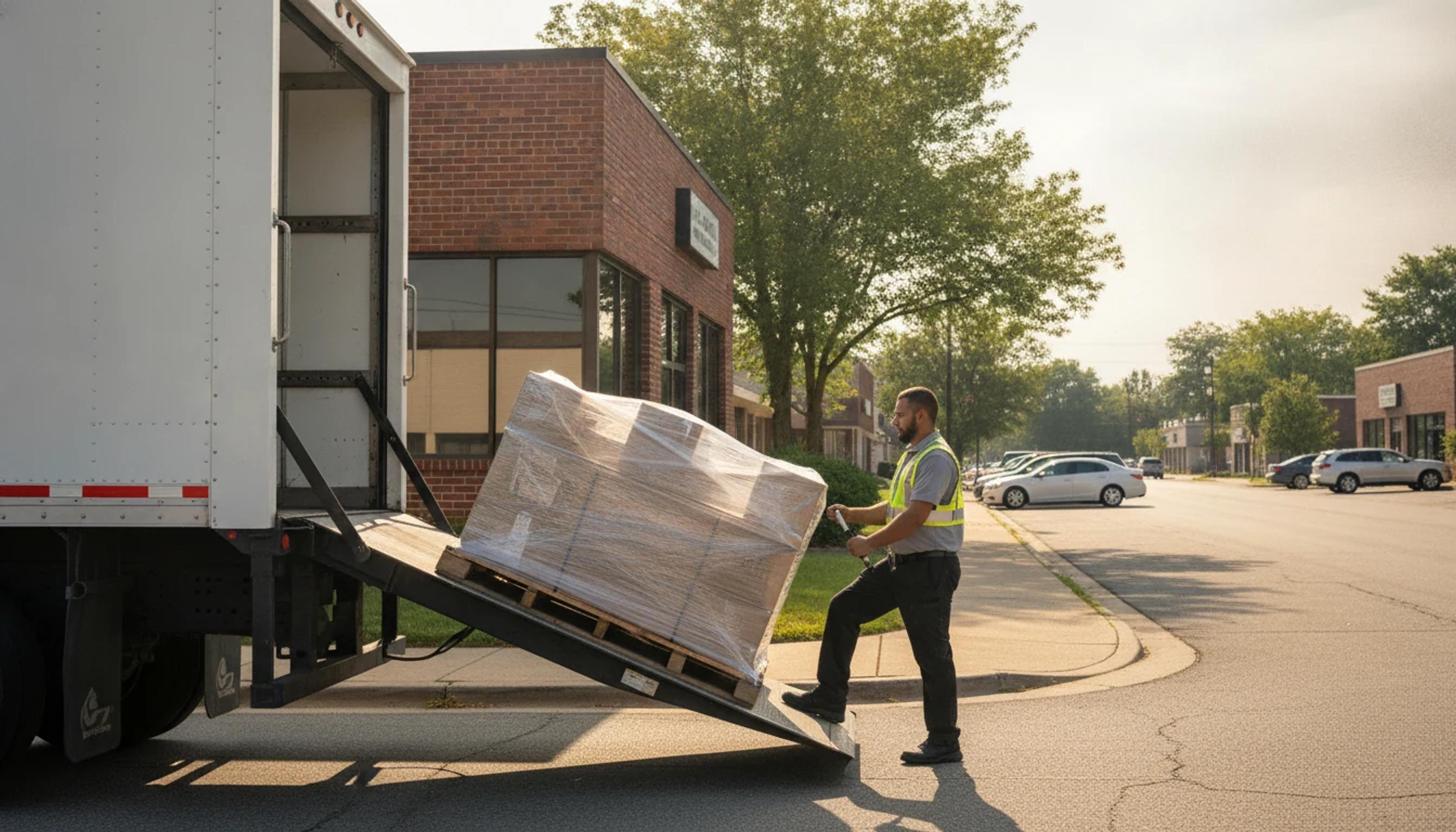
Liftgate service is the most common LTL accessorial. A liftgate is a hydraulic platform on the back of a delivery truck that raises and lowers freight between trailer height (approximately 48 inches) and street level. Any delivery without a matching-height loading dock or a forklift requires a liftgate.
| Carrier | Liftgate pickup | Liftgate delivery | Both ends |
|---|---|---|---|
| FedEx Freight | $155-185 | $155-185 | $290-340 |
| Old Dominion | $125-165 | $125-165 | $235-290 |
| Estes Express Lines | $115-155 | $115-155 | $215-275 |
| XPO LTL | $135-175 | $135-175 | $255-315 |
| Saia | $125-160 | $125-160 | $225-285 |
| TForce Freight | $125-165 | $125-165 | $235-290 |
| ABF Freight | $135-170 | $135-170 | $245-305 |
2. Residential Delivery Surcharge
Residential delivery applies whenever the destination is a home or residential-classified commercial address (residential zoning, ground-floor apartment, small home-based business, or private driveway). It is separate from liftgate and almost always billed alongside it because residential addresses lack loading docks.
| Carrier | Residential delivery fee (2026) |
|---|---|
| FedEx Freight | $175-225 |
| Old Dominion | $140-220 |
| Estes Express Lines | $150-195 |
| XPO LTL | $155-205 |
| Saia | $145-195 |
| TForce Freight | $150-195 |
| ABF Freight | $155-200 |
3. Inside Delivery
Inside delivery covers movement of freight from the curb or front door to a specific location inside the destination (a garage, storeroom, office, or specific room). Standard LTL delivery ends at the curb or dock; anything beyond that is inside delivery and is billed per hundredweight (cwt) with a minimum charge.
| Carrier | Inside delivery rate | Minimum charge |
|---|---|---|
| FedEx Freight | $7/cwt | $135 |
| Old Dominion | $5-12/cwt | $125 |
| Estes Express Lines | $5.50/cwt | $120 |
| TForce Freight | $6.50/cwt | $120 |
| ABF Freight | $7/cwt | $130 |
4. Limited Access Delivery
Limited access delivery applies to destinations that require specialized handling or restricted-time delivery windows. Common limited access locations include construction sites, schools, farms, mini-storage facilities, military bases, and government buildings.
| Carrier | Limited access fee (2026) |
|---|---|
| FedEx Freight | $115-155 |
| Old Dominion | $90-140 |
| Estes Express Lines | $95-135 |
| Saia | $100-140 |
| TForce Freight | $95-135 |
| ABF Freight | $105-140 |
5. Reconsignment (Address Change After Pickup)
Reconsignment applies when the delivery address changes after freight is picked up, or when the consignee refuses the first delivery attempt and the freight must return to the terminal and be re-dispatched. Reconsignment is one of the most avoidable accessorial charges because it results almost entirely from planning errors.
| Carrier | Reconsignment fee (2026) |
|---|---|
| FedEx Freight | $115-175 |
| Old Dominion | $85-160 |
| Estes Express Lines | $95-155 |
| TForce Freight | $100-160 |
| ABF Freight | $105-165 |
6. Appointment Scheduling
Appointment scheduling requires the carrier to coordinate a specific delivery time window with the consignee before making the delivery. Some large receivers (big-box retailers, distribution centers) mandate appointments; consumer deliveries also commonly require them.
| Carrier | Appointment fee (2026) |
|---|---|
| FedEx Freight | $60-85 |
| Old Dominion | $50-75 |
| Estes Express Lines | $50-75 |
| Saia | $55-80 |
| TForce Freight | $50-75 |
| ABF Freight | $55-80 |

7. Fuel Surcharge
Fuel surcharge is not a traditional accessorial but is universally added to every LTL line-haul charge. Carriers update it weekly based on the US Department of Energy On-Highway Diesel price index with a one-week lag. Q2 2026 fuel surcharges ran $0.42-0.55 per loaded mile as US diesel averaged $5.64 per gallon in early May 2026, up $2.16 per gallon year-over-year.
| Diesel price (national avg) | Approximate LTL fuel surcharge (per mile) |
|---|---|
| Below $3.50/gal | $0.30-0.38 |
| $3.50-4.50/gal | $0.38-0.45 |
| $4.50-5.50/gal | $0.45-0.52 |
| Above $5.50/gal (Q2 2026 range) | $0.52-0.60 |
8. Hazmat Handling
Hazardous materials shipments require additional documentation (Hazmat BOL), driver certification, and often special routing. Most carriers charge a flat hazmat accessorial of $45-75 per shipment. Class 7 (radioactive) and some Class 1 (explosives) shipments may be excluded entirely by some carriers.
9. Driver Assist / Sort and Segregate
Driver assist applies when the driver is required to help unload freight (rather than the consignee providing labor). Sort and segregate applies when the consignee wants the freight organized in a specific way at delivery. Both typically cost $40-75 per shipment across the major US LTL carriers.
10. Storage / Detention
Storage or detention fees apply when freight is held at a carrier terminal (storage) or when a driver waits at the pickup or delivery location beyond the standard free time window (detention). Storage typically costs $5-15 per pallet per day beyond the first 48 hours; detention typically costs $60-90 per hour beyond the first 30 minutes.
11. Redelivery Attempt
Redelivery applies when the first delivery attempt fails (consignee not available, refused delivery, wrong address). Unlike reconsignment (which changes the address), redelivery re-attempts the same address on a subsequent day. It typically costs $75-160 per attempt.
Summary Accessorial Cost Table (2026)
| # | Accessorial | Typical 2026 cost | How often applied |
|---|---|---|---|
| 1 | Liftgate service | $115-185 | 40-50% of LTL shipments |
| 2 | Residential delivery | $150-225 | Almost all consumer deliveries |
| 3 | Inside delivery | $6-12/cwt (min $120-135) | 10-15% of shipments |
| 4 | Limited access delivery | $95-155 | 5-10% |
| 5 | Reconsignment | $85-165 | 3-8% of shipments (avoidable) |
| 6 | Appointment scheduling | $50-85 | 20-30% |
| 7 | Fuel surcharge | $0.42-0.55/loaded mile | 100% of shipments |
| 8 | Hazmat handling | $45-75 | 5-10% of shipments |
| 9 | Driver assist / sort | $40-75 | 5-10% of shipments |
| 10 | Storage / detention | $5-15/pallet/day or $60-90/hr | 3-8% of shipments |
| 11 | Redelivery attempt | $75-160 | 2-5% of shipments (avoidable) |
How to Reduce Accessorial Costs
- Confirm delivery conditions with the consignee before BOL creation. Ask two questions: Do you have a loading dock, and do you have a forklift on-site. Two 'no' answers means liftgate service is required.
- Flag every required accessorial at BOL creation. Under-declaring costs more than declaring, because you pay both the accessorial and typically a reconsignment fee.
- Consolidate shipments to reduce residential per-shipment overhead. Two 500 lb residential deliveries cost 2x the accessorials of one 1,000 lb residential delivery.
- Use terminal pickup where possible for small deliveries. Most major LTL carriers allow consignees to pick up freight at the local terminal at no charge, saving the full liftgate-plus-residential stack.
- Compare accessorial tariffs across carriers, not just line-haul rates. On accessorial-heavy shipments (residential + liftgate + inside), Estes and Saia consistently price below FedEx Freight by 15-25% on total landed cost.
Frequently Asked Questions
What is an accessorial fee in LTL shipping?
An accessorial fee is any LTL freight charge beyond the base line-haul rate. Line-haul covers standard dock-to-dock delivery between commercial addresses with forklift access. Anything requiring extra equipment, extra time, or non-standard access is an accessorial.
How much does a liftgate add to LTL shipping in 2026?
Liftgate service costs $115-185 per shipment across major US LTL carriers in 2026. Adding liftgate on both pickup and delivery typically doubles the charge to $235-340.
What is the difference between reconsignment and redelivery?
Reconsignment is a change to the delivery address after pickup (typically $85-165). Redelivery is a second attempt at the same address after the first delivery failed (typically $75-160). Both are largely avoidable through better pre-pickup planning.
What is a fuel surcharge in LTL freight?
A fuel surcharge is a per-mile addition to the base line-haul rate that adjusts weekly based on the US Department of Energy On-Highway Diesel price index. In Q2 2026 the surcharge ranged $0.42-0.55 per loaded mile.
How much did LTL accessorial fees increase in 2026?
Accessorial fees rose 8-12% in the 2026 General Rate Increase cycles at major US LTL carriers, exceeding the 4.9-5.9% line-haul GRIs at the same carriers.
Do I need liftgate for residential delivery?
Almost always yes. Residential addresses lack loading docks. Combined residential-delivery-plus-liftgate accessorials typically add $265-410 to a residential LTL shipment.
What is inside delivery and how much does it cost?
Inside delivery moves freight from the curb or front door to a specific interior location. It is billed per hundredweight ($5-12/cwt) with a minimum charge of $120-135 across the major carriers.
Which LTL carriers have the lowest accessorial fees?
Estes Express Lines and Saia consistently price accessorials 10-25% below FedEx Freight, particularly on liftgate, residential delivery, and inside delivery. FedEx Freight prices at the top of the market on accessorials as part of its premium positioning.
Can I avoid liftgate charges legally?
Yes in three ways: (1) route the shipment to a commercial address with a dock, (2) have a neighboring business with a dock accept delivery for the consignee, or (3) use terminal pickup where the consignee picks up freight at the local carrier terminal at no charge.
Are accessorial fees negotiable?
Yes for shippers with sufficient volume. Carriers commonly offer discounts of 15-40% off list accessorial tariffs to shippers with committed volume above 500 LTL shipments per year on their network.
Bottom Line for US LTL Shippers
Accessorial fees now represent 30-45% of total LTL landed cost on residential-oriented shipments and 15-25% on commercial dock-to-dock moves. In 2026 they are rising faster than line-haul rates. The two most important shipper habits: confirm delivery conditions at BOL creation to avoid the double-cost trap of a reconsignment fee stacked on top of the accessorial, and compare accessorial tariffs across carriers when quoting.
Get an all-in LTL quote with accessorials included across 20+ US carriers in 30 seconds at freightrate.com/freight-calculator.